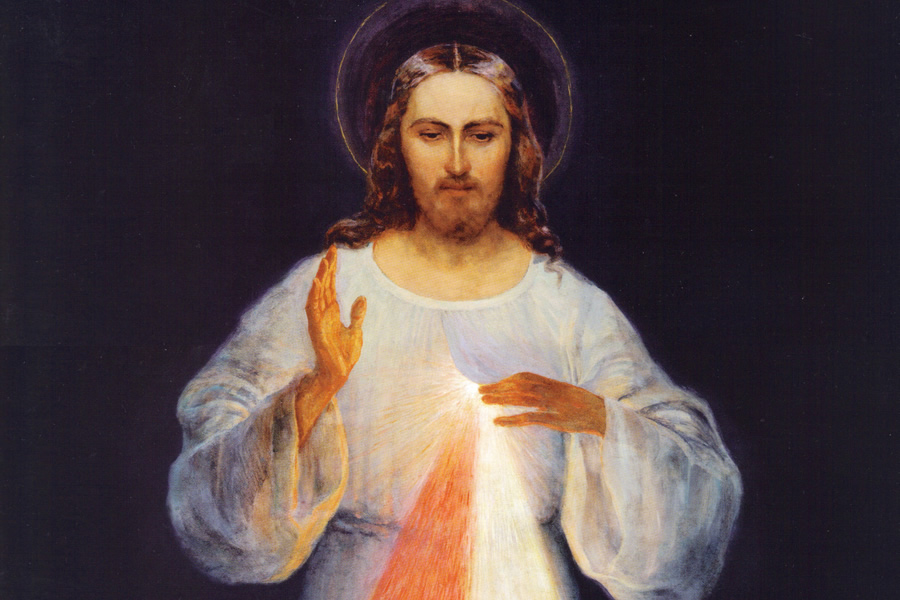
Divine Mercy Sunday
by Fr. Jerome Cayetano | 04/12/2026 | The WORD in other wordsIf you want information, I will always say: "Google it". You can practically get all information in the Google platform. I considered it to be the modern day Encyclopedia. According to Google, the "Divine Mercy Sunday originates from the private revelations of St. Maria Faustina Kowalska, a Polish nun who recorded in her diary that Jesus a wanted feast day dedicated to his profound mercy on the Sunday after Easter.” St. Pope John Paul II formally established it on April 30, 2000, thus it is celebrated annually throughout the Catholic Church on the Second Sunday of Easter.
In my Easter Sunday homily, I said that the "empty tomb" cannot be a proof of Christ's resurrection, but his appearance stories are. Today, we hear the first appearance. Jesus appeared to his disciples, and he stood in their midst. In order words, a resurrected body can pass through closed doors. It is no longer confined by time and space. Jesus said to them: "Peace be with you." In other words, a resurrected body can speak and has flesh. A resurrected body is not spirit. After Jesus had shown his hands and his side; they were incredibly happy. Then, He said: As the Father has sent me, so I send you." Then he breathed on them the Holy Spirit when He said: "Receive the Holy Spirit. Whose sins you forgive are forgiven them, and whose you retain are retained." To John the Evangelist, the giving of the Holy Spirit has happened on the first day of the week, Sunday. While in Luke, the giving of the Holy Spirit happened on the day of Pentecost, fifty days after the Resurrection of Christ. Both Evangelists agree that the Holy Spirit is the gift of Christ's resurrection.
Obviously, the Gospel account today has two episodes. The first episode happened during the evening of the first day of week when Thomas, called Didymus was not with them. The second episode took place after a week when Thomas, who after receiving the news “We have seen the Lord” from the other disciples, said "Unless I see the mark of the nails in his hands and put my finger into the nail marks and put my hand on his side, I will not believe." He is indeed the doubting Thomas whose principle is: "To see is to believe."
A week later, Jesus appeared and he said to Thomas: "Put your finger here and see my hands and bring your hand and put it into my side, and do not be unbelieving, but believe.” Thomas said and acclaimed: "My Lord and my God." Then Jesus said to him and to the rest of the disciples: "Have you come to believe because you have seen me? Blessed are those who have not seen and have believed." Just in the Gospel of John the word "believe" appears more than 100 times. For John, it means deeper faith. Not just an assent, that is, to acknowledge the existence of God/ Jesus, but it is more of acceptance that Jesus is our Lord and God. That is why not to accept Jesus means to reject him like the Jewish leaders (Scribes and Pharisees) who didn't believe in Him. Those who accept Jesus would definitely come to Him, listen to His words, follow Him and remain in Him.
The Divine Mercy Sunday must inspire, convict and challenge us, first, to appreciate and appropriate the "Mercy" of God/Jesus by going to confession regularly like St. Bridget and St. Carlo Acutis. We should not doubt his mercy and compassion. No matter how mortal or grave our sins might be, God will always forgive them. God's mercy is unfathomable! The key here is to trust the Divine Mercy of God. Thus, in confession, we should not be ashamed to confess all our sins, including the venial sins. We have just to say deep in our hearts: "Jesus, I trust in you."
Second, we must realize that "to doubt our faith" is not bad. It is a normal process, in fact, it is an opportunity given to us by the Lord to go deeper into our faith by searching, by researching, by reading, by asking questions and clarifications etc. So, in doubt, ask the right and pertinent question, and more importantly, ask the guidance of the Holy Spirit.
Third, every time we celebrate the Holy Eucharist or the Holy Sacrifice of the Mass, we are given the opportunity to gaze on Jesus and acclaim him by saying: "My Lord and my God" when the sacred host is elevated during consecration. And when the chalice is held up high by the priest, let us say in our hearts: "Lord, have mercy on me a sinner."
Happy Divine Mercy Sunday!
BACK TO LIST